hey, wanted to take somebody out :) or do something for your self , fit into Formula .
Tuesday, December 28, 2010
Saturday, December 25, 2010
Friday, December 24, 2010
Concise notes Load Balancing HSRP, VRRP, GLBP
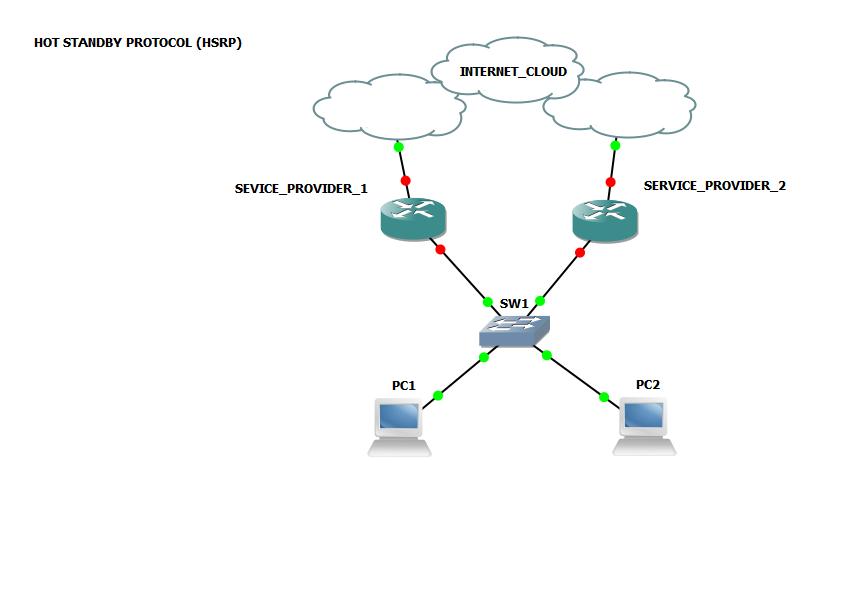
Hot Standby Router Protocol (HSRP) : Download this
provides network redundancy for IP networks, ensuring that user traffic immediately and transparently recovers from first hop failures in network edge devices or access circuits .HSRP allows multiple routers to share a virtual IP and MAC address so that the end-user hosts do not realize when a failure occurs.
Some of the key HSRP features are as follows:
■ Virtual IP address and virtual MAC active on the Master routerf
■ Standby routers listen for Hellos from the Active router, defaulting to a 3-second hello interval and 10-second dead interval
■ Highest priority ( default is 100, range 1–255) determines the Active router, with preemption disabled by default
■ Supports tracking, whereby a router’s priority is decreased when a tracked object (interface or route) fails
■ Up to 255 HSRP groups per interface,
■ Virtual MAC of 0000.0C07.ACxx, where xx is the hex HSRP group
■ Virtual IP address must be in the same subnet as the routers’ interfaces on the same LAN
■ Virtual IP address must be different from any of routers’ individual interface IP addresses
■ Supports clear-text and MD5 authentication (through a key chain)
HSRP, VRRP, and GLBP, can track interface states.can track based on the line protocol or the IP routing table.
Because HSRP uses only one Active router at a time, any other HSRP routers are idle. To provide load sharing in an HSRP configuration, the concept of Multiple HSRP, or MHSRP, was developed.In MHSRP, two or more HSRP groups are configured on each HSRP LAN interface, where the configured priority determines which router will be active for each HSRP group.
MHSRP requires that each DHCP client and statically configured host is issued a default gateway corresponding to one of the HSRP groups and requires that they’re distributed appropriately. Thus, in an MHSRP configuration with two routers and two groups, all other things being equal, half of the hosts should have one HSRP group address as its default gateway, and the other half of the hosts should use the other HSRP group address.
HSRP is Cisco proprietary,
Virtual Router Redundancy Protocol (VRRP) :
VRRP (RFC 3768) provides a standardized protocol to perform almost the exact same function. VRRP implementation has the same goals in mind as HSRP but with these differences:
■ VRRP uses a multicast virtual MAC address (0000.5E00.01xx, where xx is the hex VRRP group number).
■ VRRP uses the IOS object tracking feature, rather than its own internal tracking mechanism, to track interface states for failover purposes.
■ VRRP defaults to use pre-emption, but HSRP defaults to not use pre-emption. Both can be configured to either use pre-emption or not.
■ The VRRP term Master means the same thing as the HSRP term Active.
■ In VRRP, the VRRP group IP address is the interface IP address of one of the VRRP routers.
Gateway load balancing Protocol (GLBP) :
is a newer Cisco-proprietary tool that adds load-balancing features in addition to gateway redundancy features. Hosts still point to a default gateway IP address, but GLBP causes different hosts to send their traffic to one of up to four routers in a GLBP group. To do so, the GLBP Active Virtual Gateway (AVG) assigns each router in the group a unique virtual MAC address, following the format 0007.B400.xxyy, where xx is the GLBP group number, and yy is a different number for each router (01, 02, 03, or 04). When a client ARPs for the (virtual) IP address of its default gateway, the GLBP AVG replies with one of the four possible virtual MACs. By replying to ARP requests with different virtual MACs, the hosts in that subnet will in effect balance the traffic across the routers, rather than send all traffic to the one active router.Cisco IOS devices with GLBP support permit configuring up to 1024 GLBP groups per physical interface and up to four hosts per GLBP group.
Tuesday, December 21, 2010
How to configure Cisco ROUTER as DHCP server
WHAT is a DHCP server :
In a network, a DHCP server manages a pool of IP addresses, as well as default gateway details, DNS details and other information for the clients’ network configuration. When a new computer is introduced into a DHCP server-enabled network, it will send a query to the DHCP server requesting all the necessary information. When the query reaches the DHCP server, it will grant the new computer a new IP address and a lease - a time frame for which the computer can use this IP address, as well as other configuration details. The whole process takes place immediately after the new computer boots, and to be successful, it has to be completed before initiating IP based communication with other hosts in the network.
Saturday, December 18, 2010
concise Multicast notes CCNA/CCNP/CCIP/CCIE
Multicast :
What is IP Multicast :
IP multicast is a bandwidth-conserving technology that reduces traffic by simultaneously delivering a single stream of information to potentially thousands of corporate recipients and homes. Applications that take advantage of multicast include video conferencing, corporate communications, distance learning, and distribution of software, stock quotes, and news.
IP multicast delivers application source traffic to multiple receivers without burdening the source or the receivers while using a minimum of network bandwidth. Multicast packets are replicated in the network at the point where paths diverge by Cisco routers enabled with Protocol Independent Multicast (PIM) and other supporting multicast protocols, resulting in the most efficient delivery of data to multiple receivers.
Reverse Path Forwarding (RPF)
PIM uses the unicast routing information to create a distribution tree along the reverse path from the receivers towards the source. The multicast routers then forward packets along the distribution tree from the source to the receivers. RPF is a key concept in multicast forwarding. It enables routers to correctly forward multicast traffic down the distribution tree. RPF makes use of the existing unicast routing table to determine the upstream and downstream neighbors. A router will forward a multicast packet only if it is received on the upstream interface. This RPF check helps to guarantee that the distribution tree will be loop-free.
Multicast operation :
sparse mode : shared tree concept . explicit join , no traffic unless you ask for it
employs rendezvous point (RP) to process join request .uses pull technology.
Dense mode : source tree concept .implicit join , all traffic unless you say you want it, uses push technology , flood and prune behavior .
Sparse-Dense : sparse for a group with an RP , dense for all other .
If sparse mode assign a RP ...
to configure Statically RP use : ip pim rp-address command
to dynamically assign RP use : Auto-rp ( cisco proprietary )
bootstrap router(BSR) pim version 2 (industriy standard )
S,G : S meaning source ,G meaning group
*.G : don’t care about the source if there is an * meaning any source
show ip pim neighbor command will multicast neighbor router
shortest path tree : DR sends uni cast to RP
shared path tree : request goes to RP and come back
multicast uses UDP port
some well-known multicast address :
224.0.0.1 all multicast systems on the subnet
224.0.0.2 all multicast router on the subnet
global multicast address range 224.0.1.0 -238.255.255.255
private range 239.0.0.0 - 239.255.255.255
IGMP internet group management protocol , client use this protocol to join
a multicast group . three version available v1, v2, v3 .
using v2 client can use leave message to router , so router can drop the multicast flow.
using v3 client can specify by a join message to a multicast enable router which multicast stream they want to listen to meaning the source, by v2 it was not possible .
Cisco group management protocol (CGMP ) router tells to switch about multicast Mac address.
IGMP snooping : IGMP snooping allows switch to see IGMP query message , join message , leave message ,
What is multicast assert message :
with in multicast router if there is two path to a multicast source , client will use one path based on unicast routing table , when that route goes down ,the other router takes over and when the failed router come back online it will send an assert message to replace the backup router .
The assert election criteria are as follow in decreasing order of priority:
1- Administrative distance to the source S (10.10.10.1)
2- Cost of the route to S (10.10.10.1)
3- Highest multicast interface IP address.
When multiple PIM routers are connected to a LAN subnet, they send Assert messages
to determine which router will be the forwarder of the multicast traffic on the LAN.
Both PIMDM and PIM-SM routing protocols use assert messages.
A PIM-DM router sends Prune and Graft messages based on the demand for multicast
group traffic. If nobody wants the group traffic, the PIM-DM router sends a Prune
message to its upstream router. If somebody requests group traffic and the router is not
receiving the traffic from its upstream router, it sends a Graft message to its upstream router.
DOWNLOAD this notes Download now
Subscribe to:
Posts (Atom)